
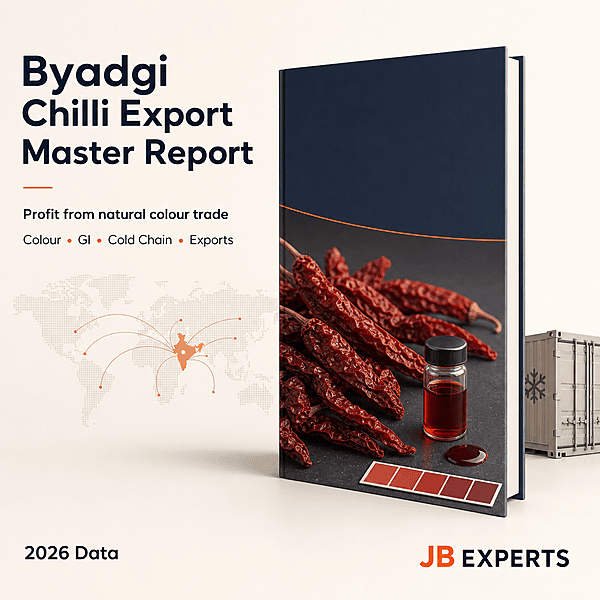
Byadgi Chilli Export Business Master Report JBE-BYD-MASTER
Byadgi is not a chilli business. It is a natural colour business that happens to use a chilli as its raw material — and almost every commercial decision follows from that.
Byadgi is bought for colour, not heat. Everything else follows.
The Byadgi chilli of Karnataka carries an ASTA colour value commonly cited at 156.9, with colour units of 150,000 to 250,000 — and capsaicin described in the GI documentation as negligible, around 0.03%. Its heat sits at 8,000–15,000 SHU against 70,000–90,000 for Teja. Buyers do not purchase it to make food hot. They buy it because it delivers intense natural red without synthetic dyes, and because roughly 50 litres of oleoresin come from a tonne of it.
It holds Geographical Indication number 129, granted in 2011. The Byadgi market yard is the second-largest red chilli market in India, turning over around ₹3 billion a year. And one industry source describes Byadgi as fetching the highest price of any Indian chilli variety in food colouring and paprika oleoresin markets.
The single most valuable operational fact in this report
Byadgi held in cold storage at around 4 to 6 °C retains colour and purity and yields 30% to 40% more oleoresin. In a product sold for extractable colour, cold storage is not a cost of holding stock. It is a manufacturing step — and the government co-funds it through cold chain schemes.
And two things this report will not pretend otherwise about
The price does not behave. Peer-reviewed analysis of the Bangalore market across 2002–2024 records a modal price instability index of 115.83%.
The GI protects the name, not the price. Byadgi-type chilli is grown in Kurnool and Adoni in Andhra Pradesh, and high-colour hybrids from there increase supply and prevent runaway prices.
What you walk away knowing
● Whether Byadgi suits you, scored against eight weighted criteria — 39/50
● The colour economics — ASTA, capsanthin, oleoresin yield — that set every price in this trade
● Kaddi vs Dabbi vs Dyavanur Deluxe, and why selling them as one grade gives away the difference
● What GI authorised user status is actually worth, and the segregation obligation that comes with it
● What a grading, cold storage, powder or extraction operation costs — with break-even calculated
● Why open roadside drying causes reported quality losses of 70–80% and destroys the colour you are selling
● The full compliance stack: aflatoxin, MRLs, ethylene oxide with 2-chloroethanol, and Sudan dyes — the specific fraud risk in a colour product
● The free variety-specific support almost nobody claims: a PMFME Handbook for Byadgi Chilli Processing and a KVIC project profile
What is inside
Four complete business models — Domestic, Processing & Extraction, Merchant Trading and Export — across 73 sections with 2026 data. Both operational flowcharts with decision gates including the GI segregation gate and the cold storage decision. A go/no-go scorecard. A full costed organic GI consignment to Germany. A 90-day action plan. Risk registers and the twelve mistakes first-time Byadgi exporters make.
Who this is for
Byadgi, Haveri, Dharwad and Gadag traders wanting to sell certified colour instead of sacks. Anyone weighing a cold storage investment in the belt. Merchant exporters entering the natural colour trade. Anyone currently supplying Cochin who wonders where the margin went.
Format and delivery
95-page book-format report, delivered as an instant digital download after purchase.
Want it pressure-tested against your own plan?
Book a 60-minute 1:1 export business consultation with JB Experts' leadership — trade or process, cold storage sizing, GI structuring, market sequencing: https://meeting.jbexperts.com/#/60min