
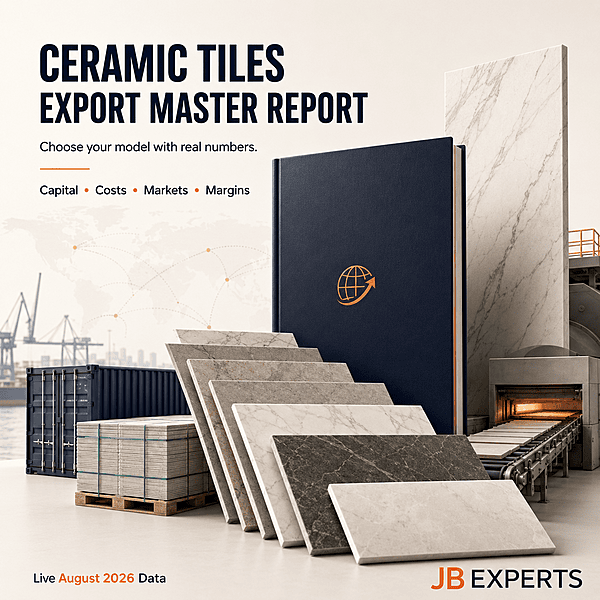
Ceramic Tiles Export Business Master Report
You stop guessing, and you start with the numbers already in front of you.
Most people entering the ceramic tile business make the decision on a supplier's price list and a competitor's Instagram feed. Then the fuel price doubles, freight rises eightfold, and a market they had built their plan around falls 98% in one quarter. All three of those things happened in 2026.
This report is the complete intelligence file for ceramic tiles — 105 pages, 73 sections, 113 data tables, across eight parts. It costs all four routes into this business end to end and then puts them side by side in a single comparison table, so you choose your model on arithmetic rather than on hope.
What you walk away knowing
- Whether ceramic tiles deserve your capital at all — a weighted go/no-go scorecard with the honest verdict
- Which export markets are worth quoting right now, ranked separately on price and on payment terms across 15 destinations
- What prices and margins survive at every product tier, from glazed wall tile to 1200×2400 porcelain slab
- Exactly what it costs to build a tile plant — machinery-by-machinery CAPEX at three scales, from ₹38 crore to ₹122 crore
- Your fixed costs, variable costs and total monthly operating cost at 50%, 70% and 90% capacity, with the break-even volume calculated
- Where to source in India as a merchant trader without a factory — named clusters, supplier types, a nine-point evaluation scorecard, and the procurement terms to insist on
- The payment terms each market actually offers a new exporter, and which ones to touch only on prepayment
- Every document required in India and at each destination border
- Which Export Promotion Council applies (it is CAPEXIL, and most guides get this wrong), what it costs, and every government incentive available
- Who the buyers are, and the five named routes to reaching them — including the trade fairs that matter
- What is happening in this market right now: the Strait of Hormuz closure, the Morbi shutdown, the 25–40% cost increase, the EU anti-dumping duty, the US countervailing duty order, and the tariff layer that changes between shipment and entry
- How to make this business survive its first three years
What is inside
- Part One — Product intelligence, global and Indian market data, live 2026 market scenario, go/no-go decision framework
- Part Two — The domestic business: market, competition, margins, registrations, capital and a 12-month plan
- Part Three — Manufacturing: process flow, bill of materials, full CAPEX schedules, operating economics, quality systems, manpower, approvals, five-year P&L and returns
- Part Four — Merchant trading: sourcing map, supplier evaluation, procurement terms, landed-cost build-up, working-capital cycle
- Part Five — The export deep dive across 32 sections: destinations, pricing, the price-versus-terms matrix, standards, compliance, certifications, packaging, freight, documentation, buyers, payment, Incoterms, incentives, trade agreements, rejection risks, value addition, marketing, forex, fraud detection, both operational flowcharts, and a 90-day action plan
- Part Six — Capital required across all four models compared in one table, plus every funding route with eligibility and cost
- Part Seven — The nine decisions that separate the exporters still shipping in three years from the rest
- Part Eight — How JB Experts can run this business with you, or for you
Who this is for
First-time exporters choosing a product. Existing traders deciding whether to add ceramic tiles. Manufacturers evaluating a plant. Merchant exporters who want the sourcing and procurement discipline written down. Anyone who has been quoted a number for this business and wants to check it against a costed model.
Format and delivery
Book-format PDF, 105 pages, instant digital download after purchase.
Want it pressure-tested against your own capital and market? Book a 60-minute 1:1 export business consultation with JB Experts' leadership: https://meeting.jbexperts.com/#/60min