
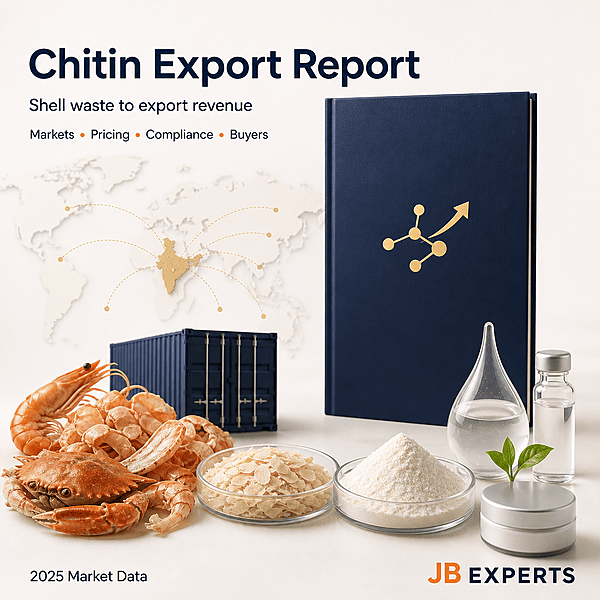
Chitin & Chitosan Export Product Analysis Report
The definitive 28-section export intelligence report on Chitin & Chitosan (HSN 39139090) — covering global market analysis, buyer identification, pricing benchmarks, regulatory compliance, operational flowchart, and a step-by-step market entry strategy. Built by export practitioners with 12+ years of hands-on experience across 17+ industries.
India is the world's #1 exporter of chitin and chitosan under HSN 39139090. The global chitin market is valued at USD 2 billion in 2025 and projected to reach USD 3.9 billion by 2036, with the broader chitin and chitosan derivatives market expected to cross USD 10 billion by 2034. Demand is accelerating across pharmaceuticals, agriculture, water treatment, cosmetics, and biodegradable packaging — and Indian manufacturers are sitting on a massive, underutilized advantage: abundant, low-cost crustacean shell feedstock from the world's second-largest aquaculture sector.
This report gives you everything you need to convert that advantage into export revenue.
What is covered in this report:
Section 1 — Product Overview and Classification: Chemical identity, product forms traded internationally (flakes, powder, chitosan, oligosaccharides, nanofibers), and CAS/molecular data.
Section 2 — HSN Code and Tariff Classification: Correct HSN 39139090 classification, GST treatment, export duty status (NIL), and RoDTEP eligibility.
Section 3 — Product Grades and Specifications: Detailed breakdown of Industrial, Food, Pharmaceutical, Cosmetic, and Agricultural grades with DDA percentages, purity levels, and FOB price ranges for each.
Section 4 — Raw Material and Sourcing: Shrimp shell, crab shell, squid pen, fungal, and insect biomass sources across India with procurement costs and chitin yield percentages.
Section 5 — Manufacturing Process: Complete 8-step extraction process from shell collection to milling and grading, including capital investment overview for a 5 to 10 MT per month facility.
Section 6 — Global Market Size and Growth: Market valuation, CAGR projections, regional market share breakdowns (North America, Europe, Asia-Pacific), and six key growth drivers with real-world data.
Section 7 — India's Export Position: India's #1 global ranking, shipment volumes, YoY growth rates (81% growth in chitosan exports), number of active exporters, key export ports, and competitive advantages.
Section 8 — Top Importing Countries: Ranked table of 10 primary buyer markets (Vietnam, China, Belgium, Japan, South Korea, France, USA, Germany, Thailand, Malaysia) with market share, primary applications, and growth trends. Plus 5 emerging high-growth markets.
Section 9 — Top Exporting Countries (Competitors): 7-country competitor matrix with shipment volumes and key strengths.
Section 10 — Pricing Analysis: FOB India, CIF Europe, and CIF Japan pricing for every grade from raw chitin flakes ($3 to $10 per kg) to pharmaceutical-grade chitosan ($80 to $150+ per kg) and chitosan oligosaccharides ($100 to $300+ per kg). Plus pricing factors and certification premiums.
Section 11 — Demand Drivers and End-Use Applications: 7 application sectors (Agriculture, Water Treatment, Healthcare, Food, Cosmetics, Industrial, Animal Feed) with market share, use cases, and growth outlook.
Section 12 — Buyer Personas and Target Segments: 7 detailed buyer types — pharmaceutical companies, agricultural biotech firms, water treatment companies, cosmetics brands, food processors, chitosan converters, and research institutions — with typical order sizes and key markets.
Section 13 — Regulatory and Compliance Requirements: India-side export requirements (IEC, GST, FSSAI, MPEDA, Pollution Control Board) plus destination-specific regulations for EU (REACH), Japan, USA (FDA), South Korea (MFDS), China (CFDA), and Australia (APVMA/TGA).
Section 14 — Quality Standards and Certifications: 10 certifications with relevance descriptions and cost estimates in INR — ISO 9001, FSSC 22000, GMP, Halal, Kosher, Organic, REACH, FDA, COA, and MSDS.
Section 15 — Packaging and Labelling Requirements: Standard export packaging specifications, container loading capacities, and complete labelling checklist including allergen warnings for crustacean-derived material.
Section 16 — Logistics and Shipping: 7 route-specific freight estimates (Kochi to Vietnam, JNPT to Belgium, Chennai to Japan, etc.) with transit times and shipping notes on humidity control and Incoterms.
Section 17 — Export Documentation Checklist: 16-point checklist from Commercial Invoice to REACH/FDA compliance documentation.
Section 18 — Trade Agreements and Duty Benefits: 8 FTAs and trade schemes (India-ASEAN, India-Japan CEPA, India-Korea CEPA, India-Australia ECTA, RoDTEP, Advance Authorization) with specific benefits for HS 3913.90.
Section 19 — SWOT Analysis: 5 strengths, 5 weaknesses, 5 opportunities, and 5 threats with actionable context.
Section 20 — Competitor Landscape: 10-company matrix including Primex (Iceland), Kitozyme (Belgium), Golden-Shell (China), Panvo Organics (India), Marine Hydrocolloids (India), and others — with specialization and key differentiators.
Section 21 — Risk Factors and Mitigation: 8 risks (feedstock seasonality, quality inconsistency, regulatory changes, currency fluctuation, shipping disruptions, buyer default, environmental compliance, China price competition) with specific mitigation strategies.
Section 22 — Market Entry Strategy: 3-phase roadmap — Foundation (Months 1 to 3), Market Development (Months 4 to 8), and Scale and Diversify (Months 9 to 24) with actionable steps for each phase.
Section 23 — Digital Marketing and Buyer Outreach: 6 outreach channels (LinkedIn Sales Navigator, B2B marketplaces, trade data platforms, email campaigns, YouTube, SEO) plus an 8-event trade show calendar with dates, locations, and focus areas.
Section 24 — Financial Projections and Unit Economics: Revenue projections, COGS breakdown, gross margins (40 to 65%), breakeven volume, and Year 1 to 3 revenue targets for a mid-scale exporter.
Section 25 — Government Schemes and Incentives: 8 schemes including RoDTEP, Advance Authorization, EPCG, MPEDA assistance, MSME subsidies, state industrial incentives, PMFME, and Interest Equalization Scheme.
Section 26 — Sustainability and ESG Considerations: Sustainability advantages (waste valorization, biodegradability, reduced chemical use), environmental challenges (effluents, energy, water), and ESG best practices for premium market positioning.
Section 27 — Key Contacts and Resources: 13 essential contacts including DGFT, ICEGATE, MPEDA, CIFT, FSSAI, FIEO, Volza, ECHA (EU REACH), and US FDA.
Section 28 — Operational Flowchart (Inquiry to Payment): Complete 9-stage, step-by-step workflow covering Buyer Inquiry and Qualification, Quotation and Negotiation, Pre-Production and Sampling, Production and Quality Control, Packaging and Marking, Documentation and Customs, Logistics and Shipment, Post-Shipment and Payment, and Post-Delivery Relationship Management.
Who is this report for:
This report is built for manufacturers, exporters, trading companies, and investors who want to enter or scale in the chitin and chitosan export business from India. Whether you are a seafood processor looking to monetize shell waste, an existing chitin manufacturer exploring international markets, or an export house evaluating new product categories — this report delivers the intelligence you need to make informed decisions and move fast.
Need a custom export strategy for your specific product or manufacturing setup? Book a 60-minute paid consultation with JB Experts at https://meeting.jbexperts.com/#/60min