
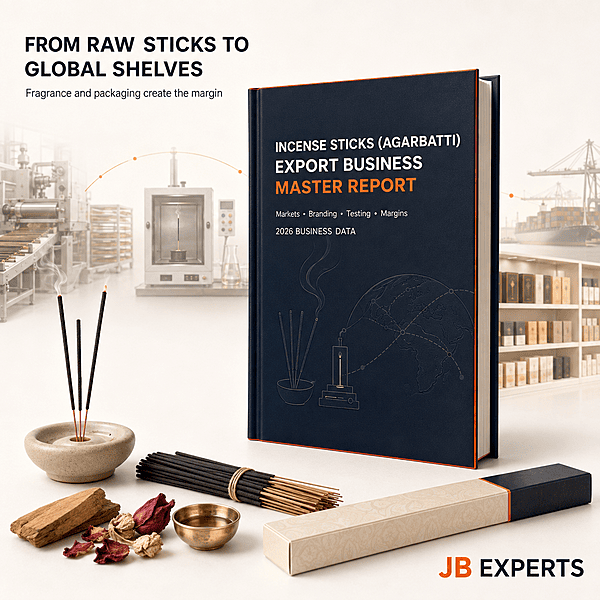
Incense Sticks (Agarbatti) Export Business Master Report
Raw agarbatti sells at ₹50–75 a kilogram. The same sticks, scented and packed for a Western shelf, reach USD 8–26 a pack. This report is about closing that gap.
In August 2019 the government restricted raw agarbatti imports. In June 2020 it raised bamboo stick duty from 10% to 25%. Those two decisions rebuilt an industry — and created the opportunity this report is about.
Before the intervention, imported raw agarbatti had gone from 2% of Indian consumption in 2009 to roughly 80% by 2019, and around a quarter of India’s agarbatti units had closed. After it, incense made in India became, in the industry’s own words, 100% made in India.
The demand underneath is large. The global incense market is roughly USD 8.7 billion in 2026, projected to reach USD 17.98 billion by 2035 at around 8.4% a year. India’s own agarbatti and dhoop market is ₹10,000–12,000 crore growing at 8.2%–8.6%. India exports to more than 150 countries and supplies over half of all US incense imports.
And the industry is wide open. Around 800 AIAMA member manufacturers, thousands of unregistered units, and the top ten organised players hold just 35% of the market. Almost all of them make good product and have no brand, no packaging and no foreign buyer.
The three things that decide whether an incense business works
Never compete on manufacture. An automatic agarbatti machine costs around ₹50,000. Rolling is not where the margin sits — fragrance and packaging are. The report shows exactly where the value is created and why the manufacturing step cannot be your advantage.
Pay for the combustion test. European authorities have removed incense sticks from the market over benzene and toluene released during burning. Incense has been named in California Prop 65 notices. That testing costs ₹25,000–₹1,50,000 per formulation and it is the entry condition for the retail channels that pay most. Almost no small Indian exporter has it.
Commit your festival capacity in June. Every year somebody wins a Diwali order they cannot fulfil because they went looking for capacity in August. The calendar in this business is unforgiving and this report sets it out month by month.
What you walk away knowing
• Whether incense suits you, scored against eight weighted criteria — it scores 42.5/50, the highest in this report series
• The raw material position after the 2019 and 2020 policy changes, and what it means for your costs today
• What capital a micro, small or integrated unit actually needs — starting in single-digit lakhs
• Your fixed costs, variable costs and real break-even, modelled for both bulk and branded mixes
• Where to source — Bengaluru, Mysuru, Tamil Nadu, Gujarat, MP and the North East bamboo belt — and the burn specification clause that protects you
• Which markets pay best and which give the safest terms across the US, UK, Malaysia, Nigeria, Gulf and EU
• The full compliance picture: combustion emissions, Prop 65, REACH, and why therapeutic claims are a trap
• Every scheme available — KVIC, PMEGP, Mudra, MAI, North East incentives — most of which nobody claims
• Why direct-to-consumer changes the economics, with the arithmetic to prove it
What is inside
Four complete business models — Domestic, Manufacturing, Merchant Trading and Export — across 73 sections with 2026 data. Both operational flowcharts with decision gates including the burn test and the market-logic split. A go/no-go scorecard. Two full costed export build-ups side by side showing why positioning beats volume. A 90-day action plan. A capital comparison across six models on one page. Risk registers, the seasonal calendar that governs cash, and the twelve mistakes first-time incense exporters make.
Who this is for
Existing agarbatti manufacturers who want to sell packs instead of kilograms. Entrepreneurs entering with modest capital. Traders building a fragrance brand without a factory. Anyone weighing incense against another product and wanting the honest case — including the competition warning that keeps its score from being higher.
Format and delivery
91-page book-format report, delivered as an instant digital download after purchase.
Want it pressure-tested against your own plan?
Book a 60-minute 1:1 export business consultation with JB Experts’ leadership — roll or source, fragrance strategy, market choice, first ninety days: