
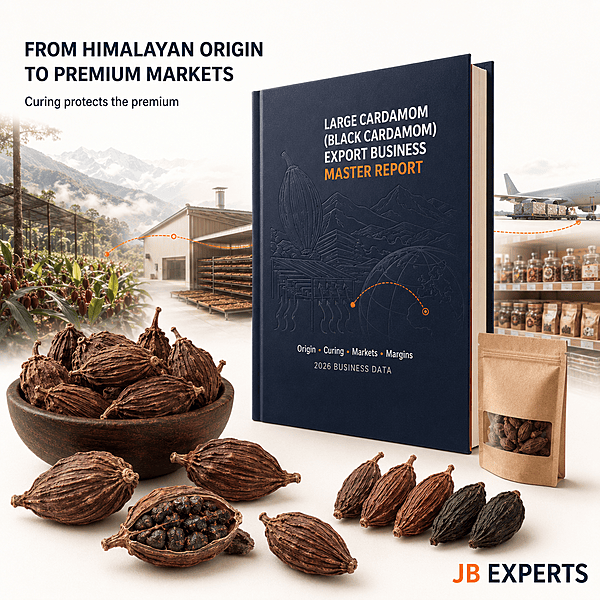
Large Cardamom (Black Cardamom) Export Business Master Report
A GI-protected, organically grown Himalayan spice that grows nowhere else on earth — and it is being cured over an open wood fire and sold as a commodity.
Large cardamom grows in one narrow Himalayan belt and nowhere else. Three countries, one species, one mountain range.
India was once the world’s largest producer with over half of global output, and Sikkim alone accounted for around 84% to 88% of India’s crop. India has since lost that leadership to Nepal, which now produces roughly 68% of the world’s supply, exports around 99% of it to India, and watches it get re-exported onward — a chain that adds a trading margin while destroying origin traceability.
Meanwhile India holds assets Nepal does not have. Sikkim large cardamom carries a registered Geographical Indication. Sikkim is a fully organic state — the crop is organic by law, not by certification effort. There is an Indian Cardamom Research Institute in Sikkim, a Spices Board auction system at Singtam, Gangtok and Siliguri, and government assistance already on offer for better curing equipment.
Almost none of it is being monetised.
Three things this report tells you that no general spice guide will
The curing problem, and exactly what fixing it is worth. The traditional bhatti dries capsules in direct contact with wood smoke for 35–40 hours at 5–15% thermal efficiency, burning 4–9 kg of fuelwood per kg cured and producing charred black pods with depleted volatile oil. The ICRI improved bhatti uses indirect heat, cures in 17–24 hours, and produces maroon capsules with 2%–2.4% volatile oil. It costs around ₹5,000 — less than four kilograms of the crop it cures. The Spices Board has promoted it for years and adoption remains limited.
The concentration risk nobody discusses. Roughly 60% of India’s large cardamom exports have been reported going to a single destination across a politically exposed border. That is a dependency, not a market position.
The price reality. This crop has traded from around NPR 700 to NPR 3,000 per kilogram within a decade — from USD 28/kg in 2014 to USD 10/kg in 2017. Against a cost structure where raw material is 62% to 82% of your selling price.
What you walk away knowing
• Whether large cardamom suits you, scored against eight weighted criteria — 38.5/50, with the highest value-addition headroom score in this report series
• The full grade structure: Badadana, Chotadana, and the bold/medium/fine millimetre bands where bold commands a reported 20%–30% premium
• What capital a trading, curing-programme or integrated operation needs — with working capital sized separately, because that is the number that matters
• Where to source across Sikkim, Darjeeling, Kalimpong, Arunachal and the North East, and why buying in Siliguri destroys your origin claim
• How to actually claim the GI and certify the organic status — the two cheapest high-value actions available
• Which markets pay best, and why Europe, Japan and diaspora retail are effectively unserved
• Spices Board CRES, the HACCP subsidy, the improved-bhatti assistance, and the North East schemes almost nobody claims
• The harvest calendar and the two deadlines — June and July — that decide the whole season
What is inside
Four complete business models — Domestic, Curing & Processing, Merchant Trading and Export — across 73 sections with 2026 data. Both operational flowcharts with decision gates including the curing-method decision and the intake acceptance gate. A go/no-go scorecard. A full costed premium air-freight consignment to Germany. A 90-day action plan. Risk registers, the price history that defines the trade, and the twelve mistakes first-time exporters make.
Who this is for
Sikkim and Siliguri traders wanting a defensible position instead of a trading margin. Anyone entering the spice trade who wants a product with almost no competing origins. Exporters looking for a genuine premium story rather than a commodity. Anyone weighing large cardamom against another crop and wanting the honest case — including the price volatility that should give you pause.
Format and delivery
96-page book-format report, delivered as an instant digital download after purchase.
Want it pressure-tested against your own plan?
Book a 60-minute 1:1 export business consultation with JB Experts’ leadership — trade or process, curing programme, GI and organic claims, market sequencing: