
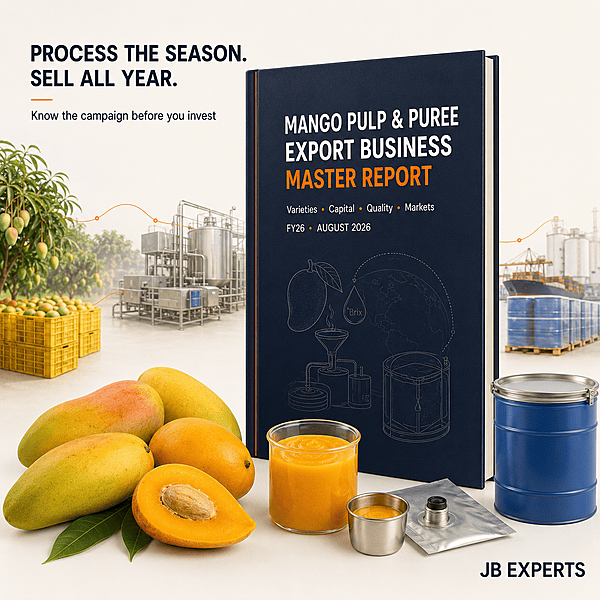
Mango Pulp & Puree Export Business Master Report
The complete commercial picture of mango pulp export — capital at three plant scales, the seasonal cost structure, sourcing map, buyer markets and full compliance route, in one report. Built on current FY26 APEDA trade data.
India grows more mangoes than any country on earth and exports over half the world’s mango pulp. And yet India’s own pulp export volume has contracted materially since FY23 — 62,864 MT worth USD 68.39 million in FY26, against roughly 109,500 MT three years earlier. That gap is the opportunity, and understanding why it opened is the first thing this report gives you.
This is a business dominated by one structural fact: the plant runs for sixty to a hundred days and sells for three hundred and sixty-five. Every decision — capital sizing, working capital, market choice, pricing — follows from it. This report is built around that reality rather than around a generic export template.
What you walk away knowing:
The question | Answered in |
Should I pick this product at all? | A scored Go / No-Go decision matrix, plus who should and should not enter |
Which markets are the good ones? | Top-10 destination analysis built on FY26 DGCIS data, plus emerging markets |
What prices and margins can I actually get? | Price tables by variety and product form — domestic ex-works, FOB, CIF and destination — with a full value-addition ladder |
How much capital do I need to manufacture? | CAPEX line by line across Micro, Small and Medium plant scales, from ripening chambers to aseptic filler |
What are my fixed, variable and monthly costs? | Annualised fixed cost, variable cost per MT by variety, and total campaign cost at 50%, 70% and 90% utilisation |
Where do I procure, and on what terms? | The Chittoor–Krishnagiri cluster map across nine regions, processor evaluation protocol and the exact procurement terms to insist on |
Which market pays best, and which gives the best terms? | A 12-market price vs payment-terms matrix telling you where to start and where to grow |
What documents do I need in India and at destination? | Full India-side compliance table plus destination requirements for the top four markets |
Which export promotion council, and what incentives? | The APEDA route in detail — RCMC, Financial Assistance Schemes, trade fairs and how to use them in year one |
How do I actually make this succeed? | Ten specific success factors and the operational flowcharts from inquiry to realised payment |
Report scope: four complete business models — Domestic Business, Manufacturing, Merchant Trading and Export — across 73 sections and eight parts, built on FY26 APEDA and DGCIS trade data, the 2026 crop position, current supplier quotations and the live tariff, freight and regulatory environment.
Inside you will also find: global and Indian market sizing with the full range of published estimates; the current international market scenario including the 2026 short crop, administered Totapuri pricing in Chittoor and the shifting US tariff position; HS classification across every product form with the classification trap most exporters fall into; variety-by-variety specification tables covering Brix, acidity, pH, colour and commercial sterility; certification sequencing and cost from Halal to BRCGS; packaging, labelling and container loadability; a full FOB-to-CIF cost build-up for an 18 MT container to the Gulf; freight ranges to thirteen destinations; buyer personas with named trade fairs and prospecting channels; payment terms and the trade finance instruments that actually fund a 200-day cycle; forex and FEMA compliance; adulteration detection and a food-grade buyer claim protocol; the fifteen most common first-time exporter mistakes with their specific consequences; both Manufacturer Exporter and Merchant Exporter operational flowcharts with decision points; a season-by-season procurement calendar; a 90-day export action plan with costs; a capital comparison across all four models; and a complete financial options table.
Who this is for: entrepreneurs evaluating mango pulp as a product; food processors with idle capacity outside their own season; merchant traders with Gulf or European buyer relationships; entrants planning an aseptic processing plant; and existing exporters in this product struggling with fruit cost volatility, campaign economics or quality claims.
Format and delivery: 84-page professionally formatted document, delivered as an instant digital download after purchase. Data current as at August 2026.
For a private session to pressure-test this plan against your own capital, fruit access and market choice, book a 60-minute 1:1 export business consultation: https://meeting.jbexperts.com/#/60min