
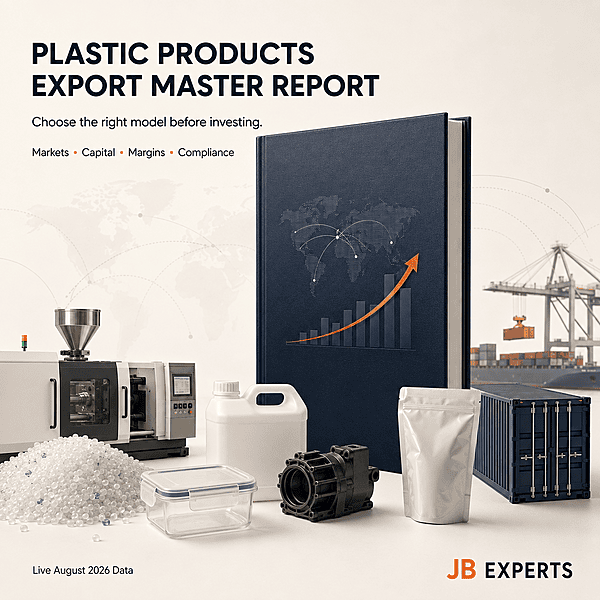
Plastic Products Export Business Master Report
You are about to make a capital decision on incomplete information
Most people entering the plastic products business make the decision twice. The first time on enthusiasm, and the second time — eighteen months and a lot of money later — on facts they wish they had seen at the start. This report exists so that you only make it once.
India exported USD 12,468.7 million of plastics and allied products in FY26. The headline number was flat. The story underneath it was not. Flexible intermediate bulk containers grew 15.0 per cent while raw materials fell 7.5 per cent. Consumer and houseware rose 11.8 per cent while floor coverings fell 10.5 per cent. A flat market is not a dead market. It is a market that has quietly re-sorted itself into winners and losers, and this report tells you which side of that line your product idea sits on.
What this report gives you
Four business models, analysed separately and compared directly. Selling plastic products domestically, manufacturing them, trading them as a merchant without a factory, and exporting them are four different businesses with four different capital requirements, four different risk profiles and four different timelines to profit. Most people confuse them. This report separates them, costs each one out, and tells you which one fits the capital and involvement you actually have.
Real numbers, not ranges. Three manufacturing scales are costed line by line — a ₹73.54 lakh entry setup, a ₹4.30 crore mid-scale plant and a ₹14.20 crore integrated unit. Fixed monthly cost, variable cost per kilogram, break-even utilisation and break-even tonnage are all worked out. You will know the utilisation percentage at which your plant stops losing money before you sign for the machine.
The regulatory position as it stands today, not as it stood last year. The EU Packaging and Packaging Waste Regulation became applicable on 12 August 2026 — six days before this edition closed. India's Plastic Waste Management Amendment Rules 2026 stepped recycled-content obligations up on a fixed ladder to 2028-29. EPR for Packaging Rules took effect on 1 April 2026. PFAS limits, food-contact regimes for the EU, USA and Gulf, and BIS obligations are all set out in operational terms.
The incentive maths, corrected. RoDTEP rates and caps for non-agricultural chapters were cut to half in February 2026 and the scheme currently runs to 30 September 2026. Effective realisation on plastics now sits at roughly 0.4 to 1.1 per cent of FOB. Any costing built before that notification overstates your margin, and a great many still in circulation do. Duty drawback, EPCG, Advance Authorisation, Plastic Parks capital grants and the state-level layer are all mapped against what they actually pay.
Where the money is right now. The USA takes 17.1 per cent of India's plastics exports and the tariff position on Indian goods moved from 50 per cent to 18 per cent under the interim bilateral agreement of February 2026. The India–EU trade agreement was concluded on 27 January 2026 and takes plastics to zero duty on entry into force. The report identifies which markets to open first, in which order, and why sequence matters more than selection.
Freight and route reality. Gulf capacity is running at 60 to 70 per cent of pre-crisis levels. Container rates from JNPT sit near USD 5,030 to Genoa and USD 5,797 to New York. The report costs your landed price against current rates rather than against the numbers that were true when the disruption began, and sets out the eastern-corridor alternatives.
The complete operational sequence. Two full flowcharts take you from enquiry to realisation of payment. Incoterms selection, the payment-terms matrix that shows you where best price and best security genuinely conflict, documentation, buyer qualification, sampling, packaging and container stuffing, quality protocols and the 90-day launch plan are each given their own treatment.
Who this is for
Manufacturers already producing plastic goods for the Indian market who want to move volume abroad. Traders who want to build an export line without owning a factory. Founders evaluating whether the plastic products business deserves their capital at all. Existing exporters whose numbers were built before February 2026 and no longer reflect reality.
What you receive
A print-formatted PDF of 167 pages, laid out as a book at trade trim, with a full contents map, eight parts, seventy-three sections, three appendices including a master HS code and incentive table, and a buyer qualification checklist you can use the week you receive it. Delivered digitally on purchase.
The honest limitation
This report will tell you what is true and what to do about it. It will not do it for you. If you want the analysis and intend to execute yourself, this is the right purchase. If you want the execution handled, book a paid consultation and we will discuss which route fits.
Book a 60-minute consultation: https://meeting.jbexperts.com/#/60min