
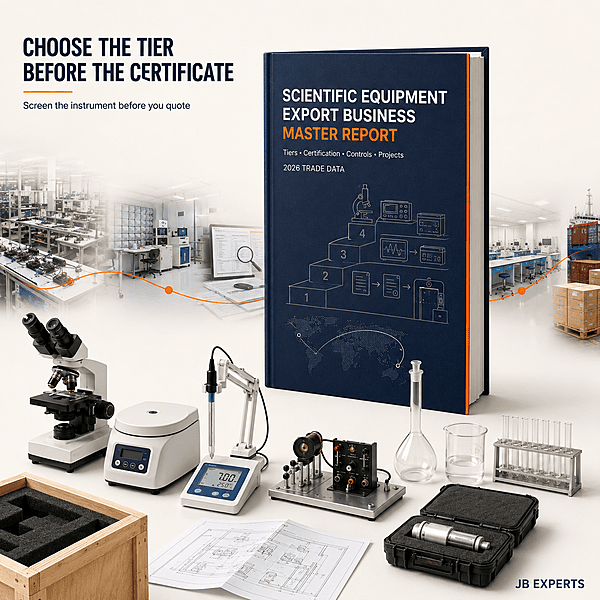
Scientific Equipment Export Business Master Report
Know which tier to enter, which certificate to buy first, and which export controls apply — before you quote your first instrument. The complete 2026 intelligence on India’s scientific equipment business.
Scientific equipment is not one product. It is four.
A five-hundred-rupee school thermometer and a two-crore mass spectrometer sit in the same category and belong to completely different industries. India competes brilliantly in two of those tiers and cannot compete at all in the fourth. Choosing wrong is the most expensive decision in this business, and most people make it before they have read anything.
This report starts by telling you which tier to stand in, and why.
The global market is worth roughly USD 37.7 to 47.6 billion and growing at 4.5% to 6.9% a year, with analytical instrumentation alone near USD 60 billion. India’s engineering exports hit an all-time high of USD 122.43 billion in FY 2025-26 — 27.71% of everything the country sells abroad — and Medical & Scientific Instruments is one of the 34 EEPC panels inside that. The Ambala cluster runs 3,000+ MSME units and a roughly ₹1,700 crore industry. The gap between the size of the world market and the size of India’s share is the opportunity, and it sits in educational apparatus, general laboratory equipment, TVET training rigs and turnkey laboratory projects — not in trying to out-engineer Thermo Fisher.
The one thing that makes this report different from every other export guide
Scientific equipment carries an export control regime. Several categories of analytical and laboratory instruments sit on India’s SCOMET list because equipment built for research can also support weapons programmes. The obligation sits on the exporter — not the customs agent, not the manufacturer — and violations are prosecuted, not negotiated. This report tells you how to screen your catalogue, your buyers and your end-uses before you quote anything.
What you walk away knowing
• Which of the four tiers to enter, scored against eight weighted criteria, with a clear verdict on who this business suits and who it does not
• The full compliance stack and the order to buy it in — ISO 9001, IEC 61010-1, IEC 61326, CE, UKCA, NRTL, ISO 13485 — and why the wrong sequence wastes ₹20 lakh
• The medical device boundary: how a marketing claim, not your hardware, decides whether you are making a regulated device
• SCOMET and dual-use export controls — the one compliance failure in this business with criminal consequences
• What capital you actually need, machine by machine, across assembly, small and medium-integrated scale — plus an honest five-year P&L that shows two loss-making years
• Your fixed costs, variable costs and real break-even revenue, which is higher than most people assume
• Where to source — Ambala, Delhi NCR, Chennai, Pune, Bengaluru, Ahmedabad by name — and how to verify a supplier’s CE claim instead of trusting it
• Which markets pay best and which give the safest terms — plus why in Africa and Central Asia you should choose the funding source, not the country
• Multilateral and development-bank procurement: the most underused, most reliable-paying channel available to an Indian instrument exporter
• Where the real money is: turnkey laboratory projects at 3–5x the underlying goods, and the 45–65% margin service annuity that most exporters throw away
What is inside
Four complete business models — Domestic, Manufacturing, Merchant Trading and Export — across 73 sections with 2026 data throughout. Both operational flowcharts, for Manufacturer Exporter and Merchant Exporter, mapped stage by stage with decision gates including the export-control screen and the device-boundary check. A go/no-go scorecard. A full costed 40-laboratory school package to East Africa including the three lines most exporters forget. A 90-day action plan week by week. A capital comparison across six models on one page. Risk registers, seasonal calendars, certification sequencing and the twelve mistakes first-time exporters make.
Who this is for
Engineers and technical founders entering the instrument business. Ambala and NCR manufacturers moving from domestic to export. Traders building a laboratory equipment catalogue. Existing exporters trying to open Europe or the US and blocked by certification. Anyone weighing scientific equipment against another product and wanting the honest case — including the reasons not to.
Format and delivery
97-page book-format report, delivered as an instant digital download after purchase.
Want it pressure-tested against your own plan?
Book a 60-minute 1:1 export business consultation with JB Experts’ leadership — your tier, your capital, your certification sequence, your first ninety days: