
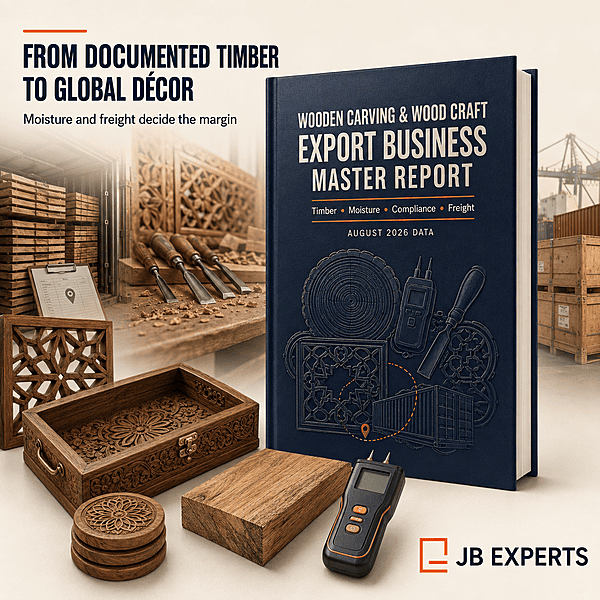
Wooden Carving & Wood Craft Export Business Master Report — 4-Model Analysis | JB Experts
Non-returnable
₹999.00 ₹9,999.00
Tags:
India now enters the US at a LOWER tariff than Vietnam or China — the first time ever in this category. Capital from ₹11.5 lakh, the freight crisis nobody has priced, and the December 2026 deadline most exporters have misread. Fully revised August 2026.
Choose Quantity
Product Details
The tariff map inverted in India's favour, and this sector has not repriced. Version 2.0, fully revised.
Indian Wood Wares exports fell from ₹8,524.74 crore to ₹7,160.96 crore in FY2025-26 — down 16.00% in rupees and 19.59% in dollars, the worst-performing major handicraft category. Using EPCH's own country table, this report establishes what caused it: the United States alone accounted for ₹1,038.58 crore of the ₹1,363.78 crore decline — 76.2% of the entire fall. Every other market combined lost ₹325.20 crore. That was never a demand collapse.
Then the cause reversed. The US tariff reached 50% in August 2025. On 20 February 2026 the US Supreme Court struck down its legal basis. The replacement took effect on 24 July 2026: India is placed in the lower 10% tier of the Section 301 forced-labour action, against Vietnam at 12.5% and China at 37.5%. And core carved décor — 4414, 4419, 4420, 4421 — was never inside the Section 232 wood tariffs at all. For the first time in this category's history an Indian carving lands in America below a Vietnamese or Chinese one. Add the India–UK CETA, in force 15 July 2026 at zero duty, and the India–EU FTA concluded on 27 January 2026 with handicrafts named.
What replaced tariffs as the constraint is freight — and almost nobody has modelled it. The Strait of Hormuz has been closed to commercial traffic since 28 February 2026. The composite container index rose about 60% between late May and mid-August. Felixstowe went from roughly USD 5,300 to USD 7,327–7,938 per 40-foot container in four months, and Jebel Ali cannot currently be quoted reliably at all. Every freight figure in this edition carries a validity date.
And there is a date most of the trade press has got wrong. On 30 December 2026 the EU Deforestation Regulation applies to wood. The micro and small enterprise deferral to June 2027 explicitly excludes wood — the carve-out sits in Article 38(3). An EPCH release of December 2025 reported it the other way. This report reads the primary text, states the discrepancy plainly, and tells you exactly what data you must be holding by December.
What you walk away knowing
•Whether to pick this product at all — a scored go/no-go matrix across eight weighted criteria with a stated verdict. The score moved from 34/50 to 39/50 between editions, and the report shows exactly which criteria moved and why
•The full US tariff position, resolved — three legal regimes in twelve months, where India actually sits today, why 4414/4419/4420/4421 are outside Section 232, and the two documents to hand your customs agent before you quote an American buyer
•What the freight crisis is doing to your container — Hormuz, the index, current rates on eleven lanes with validity dates, the carrier-versus-forwarder gap worth ₹3 lakh a box, and why a 20-foot container to Europe can cost more than a 40-foot one
•Exactly what capital you need — every model in one table: domestic, manufacturing at three scales, merchant trading and export, with startup capital, working capital, monthly operating cost, break-even, payback, and what PMEGP and PM Vishwakarma bring the promoter outlay down to
•What a carving unit costs and earns — machinery and kiln CAPEX at three scales, monthly fixed cost, variable cost per piece, total operating cost at three utilisation levels, cost and FOB by product type from coasters to jaali screens, and a five-year P&L
•The timber decision, which comes before the craft decision — nine species with prices per cubic foot, carving character, regulatory load and a clear recommendation on which to build a range on and which to price as a documented premium
•The yield number most costings get wrong — why three cubic feet of log becomes one cubic foot of carving, and what that does to a quotation built on the log price
•The moisture specification that decides whether you keep your buyer — the export targets by destination, why Indian "kiln dried" is not export dried, and the two-reading protocol that prevents three of the top five rejection causes
•The complete compliance stack — EUDR with the December 2026 date and India's LOW RISK classification, CITES and the VRIKSH Shipment Certificate for sheesham, the paperless US Lacey Act, ISPM-15 and the mistake that costs money in both directions, EU GPSR, REACH formaldehyde from 6 August 2026, toy safety, CPSIA, TSCA Title VI and California Proposition 65
•Where to source — ten named clusters from Saharanpur and Jodhpur to Channapatna, Srinagar, Mysuru, Bastar, Sankheda and Kerala, with what each is genuinely good at, supplier types, procurement terms and the red flags
•Which markets pay best and which pay most reliably — a market-by-market matrix of price against the payment terms a new exporter actually gets, and a sequencing plan for years one to three
•What prices and margins are real — verified FOB bands, verified domestic wholesale prices, verified US retail comparables showing ten to twenty-five times FOB on boards and trays, and a complete container cost build-up to the rupee with an eleven-row sensitivity table
•Every document and licence — India-side registrations with authority, validity and cost, the complete timber legality documentation pack, and the export documentation checklist
•Which Export Promotion Council — confirmed against DGFT Appendix 2T — and every incentive: the Export Promotion Mission that replaced the lapsed Interest Equalisation Scheme, PM Vishwakarma, PMEGP, state ODOP and RIPS, RoDTEP, drawback, EPCG and MAI. Including the ₹10 crore collateral-free guarantee that roughly 140 exporters in the country have claimed
•How to find buyers — verified named buyers from EPCH fair reporting, eight buyer personas with what each demands, trade shows with 2026 dates, and the LCL trial route
•How to make it work — ten success factors drawn from what actually separated the exporters who came through FY2025-26 from the ones who did not
Report scope
•Four complete business models: Domestic Business · Manufacturing · Merchant Trading · Export
•73 sections across 8 parts, with over 170 populated data tables
•Both operational flowcharts — manufacturer exporter (19 steps, 4 decision points) and merchant exporter (12 steps, 2 decision points) — plus a manufacturer-versus-merchant comparison and an inquiry-to-cash timeline
•Data current to August 2026, drawn from EPCH, DGFT, EUR-Lex and European Commission publications, CITES, USDA APHIS, CPSC, CBIC, MoEFCC, the IP India GI registry, KVIC, DC(Handicrafts), carrier tariffs and live supplier listings
•Honest about what is not knowable — hand-carved goods have no unit-price series anywhere, and any per-kilogram FOB benchmark offered for this category is a construction. The report labels every derivation and says which ratios you must measure yourself
•90-day export action plan, week by week, with deliverables and costs
Who this is for
Exporters in Saharanpur, Jodhpur and the carving clusters rebuilding after FY26 · merchant exporters who want a buyer book without a workshop · furniture and décor businesses adding an export line · anyone whose European buyer has started asking about species and geolocation · first-time entrepreneurs with ₹11 lakh upward · and anyone who has been told the EUDR deferral applies to them.
Format and delivery
119-page professional report, delivered as an instant digital download in Word and PDF format immediately after purchase.
Closing block for the listing
Want this pressure-tested against your own capital, your own cluster and your own market choice?
Book a 60-minute 1:1 export business consultation with JB Experts' leadership: https://meeting.jbexperts.com/#/60min